
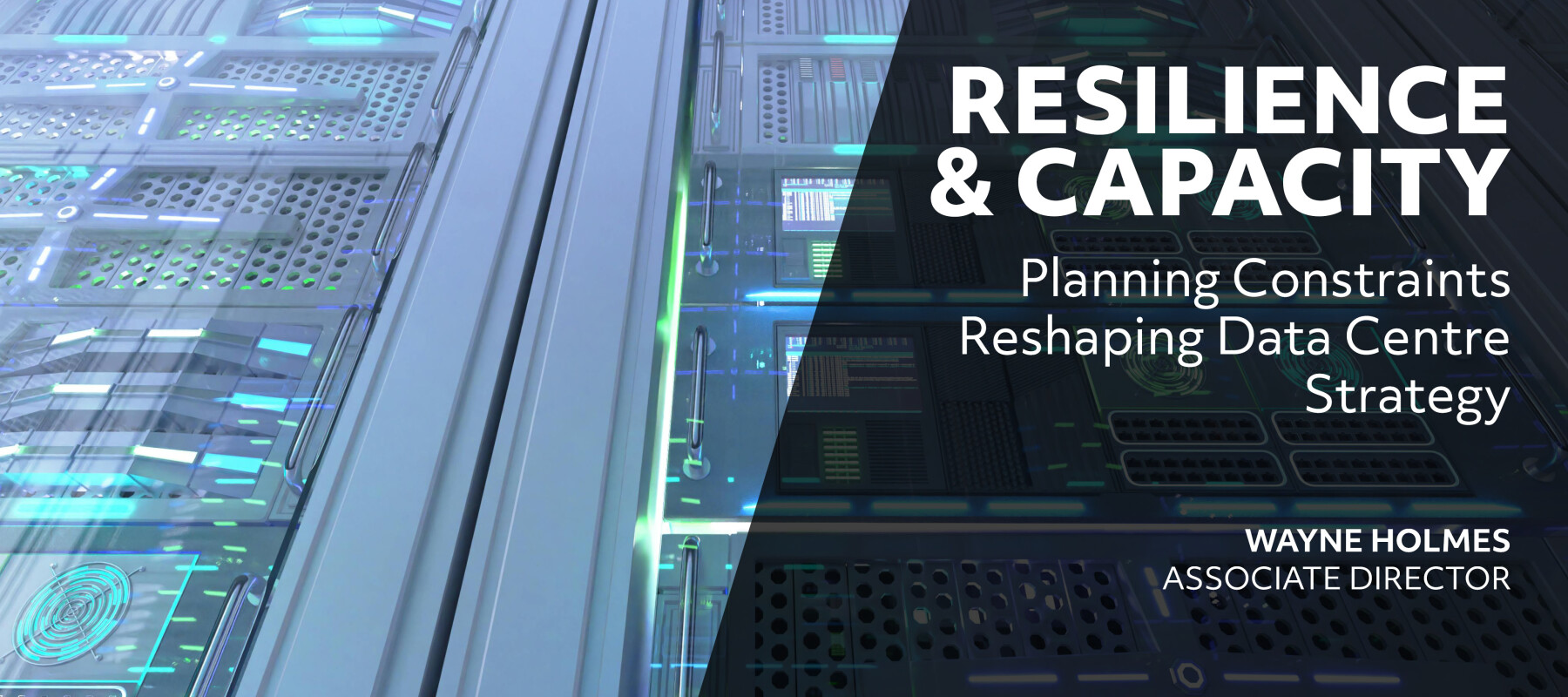
Resilience and Capacity: Planning Constraints Reshaping Data Centre Strategy
Over the past decade, Ireland has established itself as one of Europe’s most important hubs for digital infrastructure. Data centres now support a vast ecosystem of cloud computing, AI, financial services, communications, and the digital services that underpin everyday life.
Posted on 7 Jul 2026
However, the conditions under which new data centres are planned and delivered have changed significantly in recent years. Planning policies, infrastructure limitations, environmental targets, and grid constraints are increasingly influencing how and where facilities can be developed. Height restrictions, power availability challenges, and evolving sustainability policies have introduced additional complexity into the delivery of large-scale digital infrastructure.
These pressures have not slowed the sector, but they are reshaping it. Rather than relying solely on new campuses, many operators are now examining how existing facilities can be adapted to deliver greater performance and capacity.
As a result, the role of architects and design teams is shifting from a focus on expansion toward the optimisation and long-term resilience of operational assets.

From Expansion to Optimisation
For much of the industry’s growth, development centred on large, new-build campuses designed to accommodate hyperscale demand. While that model will remain part of the sector’s future, the current environment has encouraged operators to look more closely at how existing assets can deliver additional capacity.
One area of focus we find, is the reconfiguration of internal layouts to improve the efficiency of data hall space. Architectural and structural assessments often identify opportunities to increase usable white space, integrate higher-density rack environments, or optimise circulation and service zones. In some cases, plant infrastructure can also be reconfigured or expanded to support increased operational capacity within the same building footprint.
Structural analysis can also reveal opportunities for additional plant loading, particularly where rooftop or vertical plant integration can be introduced. These carefully designed interventions allow facilities to expand their technical capability while remaining within planning or site constraints that might otherwise limit development.
At the same time, resilience upgrades are becoming a central priority. As digital infrastructure becomes increasingly critical, operators are investing in improved redundancy and reliability within existing sites.

This can involve phased generator and UPS upgrades, improvements to fire compartmentation and life-safety strategies, or modifications to cooling systems to support higher-density operations.
Sustainability considerations are also playing a growing role in upgrade strategies. Improving energy efficiency, upgrading building envelopes, and assessing the embodied carbon of refurbishment versus redevelopment are all influencing how data centre assets evolve.
In many cases, extending and improving an existing facility can provide a lower-carbon pathway compared with building entirely new infrastructure.
Building Within Constraint: The Live Environment Challenge
Upgrading operational data centres presents a distinct set of design and delivery challenges. Unlike new construction projects, interventions within a live facility must be carefully managed to ensure uninterrupted service.

This requires detailed phasing strategies and close coordination between architects, engineers, contractors, and operations teams.
Construction activity often takes place within highly controlled environments where security protocols, access restrictions, and strict health and safety procedures must be observed at all times.
In many ways, the complexity resembles working within sensitive urban environments, where sequencing, coordination, and operational continuity are critical. Successful upgrades depend not only on technical design expertise, but also on a clear understanding of how architectural interventions interact with structural and services systems already operating within the building.
Conclusion
Ireland’s data centre sector is not slowing; it is recalibrating. As grid connections tighten and policy frameworks evolve, the ability to adapt existing infrastructure is becoming increasingly important.
Operators who can extract greater value from their current assets, build flexibility into design, and upgrade intelligently will be best positioned to meet future demand. We as architects, now play a key role in this process - not only delivering new buildings, but helping unlock latent capacity within existing facilities.
Our Practice has been involved in many data centre projects across Ireland and has developed a strong understanding of the technical, operational, and planning challenges that shape this sector. While many of these projects remain confidential, the experience gained continues to inform how we approach capacity optimisation, resilience upgrades, and long-term infrastructure planning.

About the author
Wayne bridges the gap between detailed technical expertise and creative design, with a strong focus on mission-critical projects. An Architect and Project Manager with experience across data centres, refurbishment, industrial, and healthcare sectors, he has contributed to a wide range of significant projects throughout his career. He continues to play an integral role across MDO’s high-performance project portfolio and is currently involved in the practice’s ongoing data centre projects.
If you would like to discuss how an existing campus might be assessed for resilience and capacity optimisation, we would be pleased to start that conversation and also introduce you to our wider team of consultants and partners.
Click here to visit MDO's Data Centre page for more info.